Ikebana Wrecked My Idea of Minimalism (And Honestly, Good)
For a solid two years, I was deep in the declutter-everything era. You probably know the one. I watched the shows, read the books, donated four garbage bags to Goodwill, and stood in my apartment feeling like I'd achieved something spiritual. Fewer things. Clean surfaces. The works.
Then I stumbled into ikebana, and it kind of broke me — in the best possible way.
Ikebana is Japan's traditional practice of flower arrangement. But calling it "flower arrangement" is a little like calling the tea ceremony "drinking tea." Technically accurate, completely missing the point. What ikebana actually is, once you start sitting with it, is a philosophy disguised as a craft. And it has a lot to say about what minimalism is actually supposed to feel like.
It's Not About the Flowers
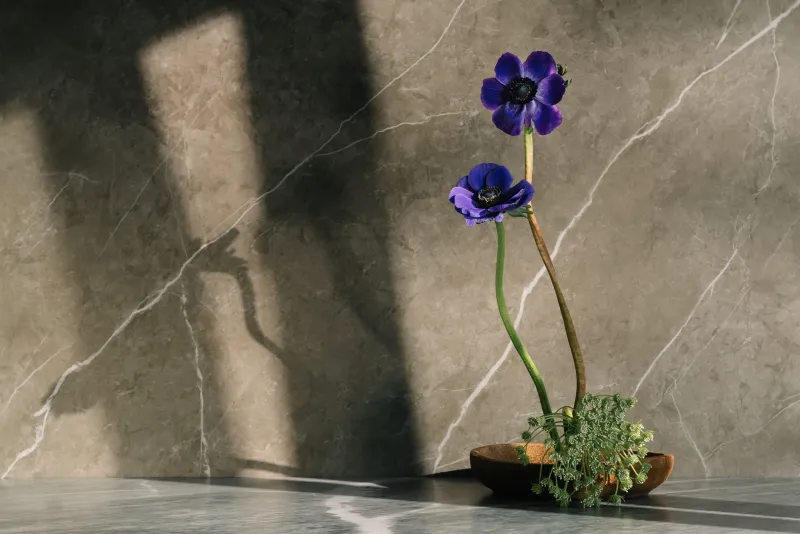
The first thing that throws people off about ikebana is the emptiness. You walk into a gallery or a studio and you expect to see the kind of lush, overflowing bouquets that show up in every Instagram aesthetic. Instead, you get three stems. Maybe five. Arranged at sharp, deliberate angles. And a whole lot of nothing around them.
That nothing is the point.
In ikebana, the empty space — called ma in Japanese — isn't a gap waiting to be filled. It's an active element of the composition. The silence between notes that makes the music make sense. Practitioners spend as much time thinking about where not to place something as they do about where to place it. The negative space isn't absence. It's presence with a different job.
This is where I started realizing my whole decluttering project had been a little shallow. I'd removed things, sure. But I hadn't thought much about what the remaining things were doing. I'd created empty surfaces, not intentional ones. There's a difference, and ikebana makes you feel it immediately.
Three Lines, One Idea
Traditional ikebana follows a structure built around three main lines — historically representing heaven, earth, and humanity (ten, chi, jin). Every branch, stem, or leaf placed in an arrangement is in relationship with these lines and with everything else in the piece.
What's wild about this is how it reframes the idea of "less." In most Western minimalist thinking, reducing down to fewer things is the goal. The fewer, the better. Clean, simple, done. But in ikebana, each element has to earn its place not just by existing, but by contributing to a living conversation between all the other elements. It's not about having three stems instead of thirty. It's about those three stems meaning something — to each other and to the space around them.
I started looking at my apartment differently after this. Not "what can I get rid of?" but "what is each thing actually doing here?" Some objects I'd kept through multiple purges turned out to be completely inert. Not ugly, not broken — just there, taking up visual energy without giving anything back. And some things I'd almost donated turned out to be load-bearing in ways I hadn't noticed. A specific lamp. A weird little ceramic bowl my friend brought back from Kyoto. Things with quiet but real presence.
Seasons Are Non-Negotiable
Another thing ikebana insists on that Western minimalism tends to skip: time. Specifically, the season you're actually in.
Ikebana arrangements are deeply tied to the Japanese concept of kisetsukan — seasonal sensitivity. You don't arrange summer flowers in November. You don't force spring into winter. The practice asks you to pay attention to what's alive right now and work with that, not against it. A bare branch in January isn't sad. It's honest.
This seasonal awareness adds a layer that a lot of minimalist content completely ignores. Decluttering guides talk about timeless spaces, capsule wardrobes built to last forever, interiors that photograph well in any month. Ikebana says: no. Your space should reflect where you actually are in the year. In the world. Right now.
There's something almost confrontational about that idea for American audiences raised on the promise that good design is permanent. Ikebana is like, your space is supposed to change. It's supposed to feel different in October than it does in April. That's not instability — that's being awake.
The Patience Problem
I'll be honest: ikebana is slow. There are schools of ikebana — Ikenobo, Ohara, Sogetsu are the big ones — and each has its own approach, but none of them are rushing you. You study for years. You learn to see before you learn to place. You develop what practitioners call an eye for the natural line of a stem before you'd ever think about cutting it.
This pace is also kind of the lesson.
Most minimalism content in the US is framed as a project with an endpoint. You do the big clean-out, you buy the matching storage bins, you're done. Ikebana has no endpoint. It's a practice in the truest sense — something you return to repeatedly, something that shows you something new every time. The arrangement you make today will be different from the one you make in three months, not because you got better, but because you're different, the season is different, the materials are different.
That's a much harder sell than a weekend declutter. But it's also a much more honest one.
What Actually Stayed With Me
I'm not going to claim I became an ikebana master or that my apartment now looks like a Kyoto tea house. It doesn't. But the practice genuinely changed how I think about objects, space, and the difference between empty and open.
Empty is just cleared out. Open is cleared out with intention — space that's doing something, that's in conversation with what surrounds it.
Marie Kondo's famous question — does this spark joy? — is a good starting point. But ikebana asks something a little harder: does this belong? Not just to you, but to this moment, this season, this specific arrangement of your life right now? That question has a lot more teeth.
And honestly? Sitting with it has been more useful than any number of donation runs.
If you're curious about trying ikebana without flying to Japan, there are workshops popping up in most major US cities — check local Japanese cultural centers or community colleges with art programs. Some ikebana schools also offer beginner online courses now. You don't need much to start: a few stems, a kenzan (that's the little spiked frog that holds your stems in place), and a willingness to let empty space be enough.